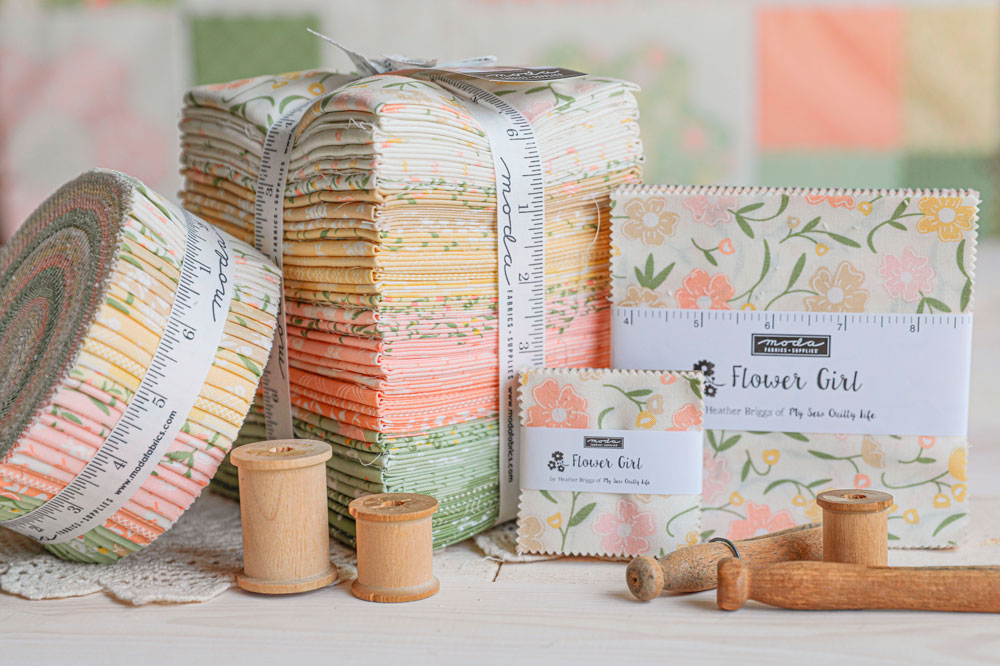
Wouldn't you love to save time binding a quilt by using strips already cut for you? Me too! Here's a fabulous way to bind your quilts with a scrumptious jelly roll. This technique is fast and accurate, every time.


Quilt, ready to be bound
Jelly roll strips
Binding clips (optional)

1. First, go ahead and measure the perimeter of your quilt. Then add 12” to that number (to make sure we don’t run short). My numbers are in red so you can follow along.
X = Perimeter + 12”
X = 68” + 12”
X = 80”
2. Take your X value and divide it by 40 to determine the number of jelly roll strips needed.
X / 40 = number of jelly roll strips needed
80 / 40 = 2 jelly roll strips
*Note: If the number of jelly roll strips needed is something like 4.13, round up to the nearest quarter (so you would need 4.25 jelly roll strips).*
3. Grab the number of jelly roll strips you need, as determined by Step 2. Snip the selvages off each end.
4. Let’s join those jelly roll strips together, shall we? Layer two jelly roll strips right sides together as pictured.
Draw and stitch on the diagonal line.
Trim seam allowance and press open.
Repeat this step with each jelly roll strip to form continuous binding.
5. Fold your binding in half, wrong sides together. Press well.
6. Place your quilt front side up. Measure 8” down from one end of your binding. Align the raw edges of the binding with the raw edge of your quilt in the middle of one side of the quilt. (See pin). If you have a walking foot, snap it on now!
7. Sew binding to quilt with a 3/8” seam allowance. When you are ¼” from the edge, pivot and sew to the corner point.
8. Fold the tail up and press.
9. Fold the tail back down and press.
10. Start stitching at the top edge, making sure to backstitch.
When you get to the next edge, repeat Steps 7-9. Continue attaching binding in this way until you are 10” from where you started.
11. Trim 1” off one of the binding edges.
12. Open the 1” piece and lay it above the beginning of the first tail we sewed down.
13. Grab the end of the other side of the tail and overlap it with the beginning of the tail. We are using the fabric above as a ruler. Trim the end of the tail at the overlap point. (See pin).
14. Open up the tails of the binding and pin right sides together at a 90 degree angle.
15. Draw and stitch on the diagonal line. *Make sure you drew your diagonal line going the right way!*
16. Trim seam allowance. Press binding down and finish stitching to quilt!
17. Press binding right side out and fold over to the back side, just a hair below the stitched line. Use binding clips to secure if desired.
18. Thread a needle with 12”-18” of thread and knot the end. Be sure to use a single thread and not double thickness. Guide the needle through the backing of the quilt and some of the batting. Poke the needle out just above the stitched line.
19. Just above where the thread came out, guide your needle into the folded edge of the binding. Be sure to keep your needle parallel to the fold. Push the needle out after traveling about ¼”. Pull thread snugly.
20. Next, guide the needle into the backing and backing. Be sure to keep your needle parallel to the stitching line. Push the needle out after traveling about ¼”. Pull thread snugly.
21. Continue stitching binding to quilt, securing thread and add new thread to your needle as needed.

One quick and snappy way to bind your next quilt!

I'd love to hear what you think,


37 comments:
I never thought of using a jelly roll! thanks for the great idea!
I cut a 45˚ angle on the end of my leading strip then, once I've gone all around, layer the ends, mark the 45˚ edge on the ending part of the binding, and add 1/2" then trim to have a perfect alignment. Been doing it for years. :) Never thought of using Jelly Rolls though! Great idea!
Seriously. Why did it never occur to any of us to use the jelly rolls?! And I love scrappy bindings, too... thanks!
Great tips! I can't wait to try it out on the two quilts waiting to get binding on them.
This method is not very cost effective if you have a larger quilt to bind and want to use a single fabric. It is, however, wonderful if you are OK with a scrappy, pieced border. It takes patience to sew all of the shorter lengths of the strips together, but the effect can be very cool. If you are working with a lot of pieced shorter strips, just be careful when you put the binding on. Play with the placement so that you don't end up with a binding seam right at the spot where you are doing the mitered corner.
Another idea is to sew the left-over strip pieces together into strip sets, cut the resulting "fabric" into a piano key strip & use as part of a back-of-the-quilt design element (or to give your backing that little extra width you need).
What a great tutorial! I need to pick up a solid color jelly roll to have on hand for bindings!
Some jelly roll patterns don't require you to use all the strips. When that is the case I always use the left overs for binding. I love the scrappy look. Thanks for the tutorial. Great tips.
Thanks for the detailed instructions. I was planning on using jelly roll strips to bind my most recent quilt. Can't wait to try it out.
What a great binding tutorial for any binding. I love your "ruler" idea. This will be great to show beginning quilters. I'm glad I have some extra jelly roll strips for the quilt I am working on! Thanks!
I've been using jelly roll strips for binding for a while now, and it is a wonderful time-saver!
love the tutorial thank for the great tip. the other day i was doing binding on my bedspread and i could not remember where i had seen the directions for sewing the binding at the end to fit perfectly. thank i will use on my next quilt.
Thanks for the refresher!
Great idea--never thought of jelly rolls for binding--although it does seem kind of obvious! Thanks for the binding refresher as well--I'm a new quilter and I'm really learning alot here at the Bake Shop.
That's awesome! The part I have trouble with is the "continue securing the thread and reloading the needles." I can never get the thread "secure" enough to not start unraveling. Any tips on that one?
Thanks for the great tutorial and pictures!
That was a great tutorial - your pictures were so self explanatory! Thanks so much! Jenn
H, MomBrose!
Here's a great tutorial on burying your knot:
http://bit.ly/bIN7e0
And then when you start your new thread, I always "re-stitch" the last stitch or two I took (basically double sewing it) to ensure it stays put.
I hope that helps :)
Great little tutorial. I've used left over strips for bindings on doll quilts etc. for a while. Its a great way of getting a nice binding without buying oodles of fabric.
Really great tutorial, and I've looked at a lot recently! Thank you, Oda May! Very clear instructions and nice photos, too.
This is so easy to understand even for 'directionally challenged' people like me!I have this book with some binding directions but I get it wrong most of the time. Now I'll get it right always!!
Thank you!!!
Now why didn't I think of that???? Thank-you sooooo much. Great tutorial - learned a few other things along the way!
If you are making a 3/8 inch seam allowance wouldn't you stop 3/8 inch from the end?
Your instructions were very clear. I can't really describe how I end my binding. I poke one inside the other and make sure I have a diagonal fold line showing.
You are fabulous! The instructions were very clear, and will help me bind any quilt. I'm a beginner and am starting.
Thank you for this. I've used jelly rolls many times for binding, but those final steps (joining the loose ends) always made me crazy and many times brought me near to tears. I've tried your trick and it works...thank you, thank you, thank you!
Love It, Thanks!!
I love all the very clear photos in this tutorial. One question, though...the directions say keep the needle perpendicular to the stitching line, but all the photos show the needle PARALLEL to the stitching line. Should the directions say parallel (along the same line) instead of perpendicular (at right angles)?
Micmaker, You are exactly right! Thank you so much for letting us know. I fixed the terminology.
Oda May
I needed a tutorial on this! THANK YOU!
I enjoyed the tutorial; I always hate finishing up the ends of the binding, so glad to read that I am not alone!!
Hi, I just found this on how to use a jellyroll for binding. what a good tutorial. I usually just use fat 1/4s and make continuous binding but i will try this next time. thanks sue~n.z.
I just printed this out to put in my notebook. Looking forward to making this binding for some of my scrappy quilts. Thank you.
Finally a binding method that seems to click with my brain. I can't wait to test this out! Thanks so much for posting the tutorial :).
I hadn't thought of using a jelly roll to bind but it makes sense. I use a similar method but think that was really interesting how you used a one inch strip to measure. Thanks for a great tutorial.
Im new to quilting and have no idea what im doing (thats how new). While searching for a easy way to sew all my strips of fabric together I found this link to binding. (had not even thought that far ahead in the quilting process) :) Once I read through your instructions there were a few areas where I was a lil fuzzy (only because I dont know all the quilting lingo) BUT second time reading and it all made perfect sense. This will be my very first method of binding a quilt! maybe I can show grandma a thing or two! :)
Did great w/your directions until I got to #11 instruction. I can't figure out for the life of me how to join the 2 ends. Your tutorial doesn't show a beginner what to do with the extra length fr where you started stitching. I'm so frustrated right now and more so after reading all the wonderful comments. Just can't figure out what I'm doing wrong!
Another great way to do the binding without binding using tool! Thanks for sharing.
I appreciate this tutorial! I have used it several times over the last year. It's nice to know I have a reliable source I can find easily. Thank you!
Post a Comment