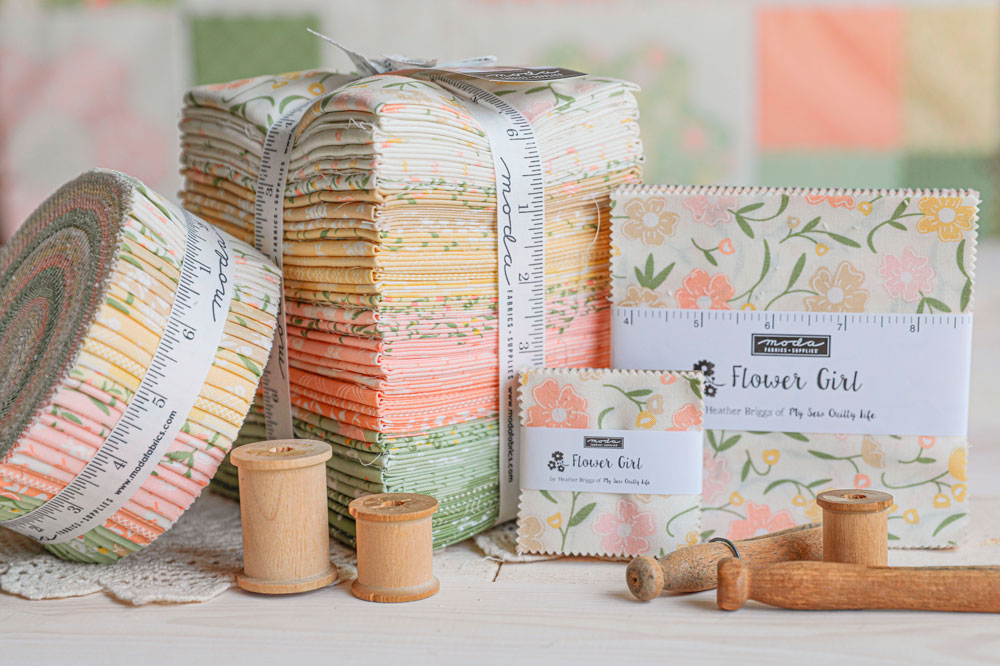
Hello! I'm Casey from Casey York Design and I blog at Studioloblog.wordpress.com. I'm delighted to be publishing my first pattern with Moda Bakeshop. This charm-pack friendly pattern features colorful French macarons, which seem to fit well with the title of this blog. For the quilt pictured, I used Kate Spain's recently released Honey Honey collection, and I am in love with this line. The colors are so cheerful and springlike and work perfectly for the candy-colored macarons. I hope you enjoy this pattern and that you'll share your finished quilts with me through the Casey York Quilts flickr group.
If you'd like to see some of my other quilts, many of which I will be releasing patterns for this spring, please stop by my blog and say hi!
Macarons appliques: (1) Honey Honey charm pack
Cake Stand applique: ½ yd.
fabric for cake stand appliqué (sample shows Bella Solids Aqua)
Background: 1 ½
yds. solid fabric (1 ¼ yds. if fabric is extra
wide)
Binding: 1 yd. contrasting fabric for binding (based on
3”wide bias-cut strips; sample shows Lace in Sunset)
Backing: 3 yds. (or multiple fabrics to measure 44" X 54" for pieced backing)
Batting: 42" X 52" (1 3/4 yds 45+" batting, or one baby-sized package of pre-cut batting)
Backing: 3 yds. (or multiple fabrics to measure 44" X 54" for pieced backing)
Batting: 42" X 52" (1 3/4 yds 45+" batting, or one baby-sized package of pre-cut batting)
Lightweight, double-sided, paper backed fusible web : 1 ½ yds. 12” wide web or
(6) 9” X 12” sheets
Step 1: Make the Appliqués:
Print the Appliqué Template page, which can be
downloaded as a PDF here. Enlarge the Cake Stand template 300% using the settings in the print dialog box that appears when you print the PDF. (The cake stand will print over multiple sheets of paper, which you will then tape together.) The Cookie and Filling templates do not need to be enlarged.
Following manufacturer’s instructions, trace templates onto
double-sided paper-backed fusible web. You will need to trace and cut (20) Cookies and Fillings and (1) Cake Stand. The cake stand may need to be traced in multiple sections, as shown below; these will be easy to reassemble when you fuse the web to the fabric in the next steps. As you will be applying these to the wrong side of your fabrics,
the templates have already been reversed for you.
Tip: make sure to trace onto the correct side
of the fusible web to avoid having to retrace your templates.
Decide which fabrics you want to use for cookies and
fillings; I used large scale prints for the cookies and smaller scale or darker
value complements for the fillings.
Cut out your traced templates and, following the
manufacturer’s instructions, fuse the shapes to the wrong sides of your charm squares and cake stand fabric. Make sure to use a pressing cloth between your iron and fabric in order to avoid getting sticky residue on your sole plate.
Tip: Leaving a small margin around the
templates when you cut them from the web is often helpful, but for this type of simple
geometric shape I find this unnecessary. For this pattern, I cut the templates out
along my tracing lines before fusing to the fabric. This saves my fabric scissors from
cutting through extra layers of paper and adhesive, which can dull and gum up
the blades. Use whichever method works
best for you.
Match up each filling with its corresponding cookie.
Although it may be tempting to fuse them together at this point, hold off on
this until the next step, otherwise the overhanging portion of the fillings
will fuse permanently to your ironing surface.
Step 2: Assemble the quilt top:
Cut and/or piece your background fabric to measure
40” X 50.”
Following the placement diagram below (click here for a PDF), arrange you appliqué
shapes on the background.
Position the
cookies about one inch apart, and finalize your layout before fusing.
Make sure to position the cake stand ¼ inch above
the bottom edge of the background fabric, so that it is not covered by the
binding when the quilt is finished. One cookie will be cut off at the left edge
of the quilt—make sure to cut this to fit before
you fuse it, to avoid fusing the edge of the cookie to your fusing surface.
Tip: Try to complete this step on the same surface you
will be ironing on. Although the unfused web is tacky, it will not necessarily hold the appliqués
in place if you move the quilt top.
Appliqué around each shape by hand or with your machine. For this example, I used invisible thread and a zig-zag stitch.
Step 3: Finish the quilt:
Layer your quilt top, batting, and backing; baste and quilt as desired. For the sample, I quilted an allover scroll pattern.
Trim batting and backing even with quilt top. Place a large bowl or plate adjacent to the edges at each corner and
trace along its outer curve to mark curved corners. Trim the quilt according to your markings.
Use your contrasting binding fabric to make bias binding and
bind using your preferred method.
Tip: bias binding will be easier to sew around the curved corners of the quilt than will straight grain binding.
This pattern will yield one 40” X 50” lap quilt, which is my
favorite size for brisk late winter days.
{studioloblog.wordpress.com}


13 comments:
Love it Casey. What a brilliant idea!
This is gorgeous and the colours are just right!
very cute, however just a little fyi you spell macaroons with 2 "oo"s
ACK! I love Macaroon's ~ this is too cute! Thanks for the tutorial too.
No cream on your cheeks with these lovely confections. Well done.
I love this quilt! I went to save it on my computer for later but the links to PDFs and the printer version are broken. I'll check back later.
This is so cute. Last year I went to Paris and London with my daughter and she said one of her favorite memories is when we bought a little box of the macarons and laid on the bed tasting them when we got back to the room. I definitely have to make this for her. Thanks for the pattern
Oh, for some of the commenters, the cookies are spelled with only one "o", they bear no resemblance to our coconut macaroons.
Thanks for your kind comments, everyone!
I just wanted to note that you are welcome to email me if you have trouble downloading the templates. I'd be happy to send you a copy. Just use the contact form on my blog, linked above. Thanks!
Shouldn't the Moda Bakeshop site be fixing the links? They still aren't working.
I stan corrected on the spelling. I apologize :)
I love macarons & this darling quilt.
Kelly, you should see if you can find the macarons, the come in different flavors and they're delicious.
Post a Comment